Sunday, June 27, 2010

Pictures At An Exhibition


Welcome to Z Food Farm. We hope to see you and get to meet you at either of our two farmers' markets or at the farm itself.


Here is David doing the first harvest at Z Food Farm. Swiss Chard had the 'honor' of being the first pick.


A big thumbs up for the first bunch. You can see some of the other crops growing on either side of David.


Here David is dunking the Swiss Chard in cold water. This serves two purposes- The first is to clean off as much of the soil from the produce as possible. The second is to rehydrate the chard. When it is cut, especially during the excessive heat we've been experiencing, the chard, as does other produce, can begin to wilt. Putting the produce in the cold water helps to revitalize the produce. Following this step the produce is then put in crates and then placed in a walk-in cooler. At this time David does not yet have a walk-in cooler. Once again Farmer Matt has come to David's aid by allowing David to utilize space in his cooler.


David is growing 14 varieties of lettuce. Some are better suited to the warmer weather than others. While it is challenging to have lettuce throughout the summer, David does seeding on a regular basis and is thus able to put new plants into the field on a steady basis. Thus, even if some of the lettuce does not do well, enough is planted to allow him to always have a supply to bring to market.


David grows two types of kale (one of those super nutritious greens). Pictured is Red Russian Kale. Not pictured is a variety named Toscano. Both varieties are crisper and creamier to taste than the traditional kale that most kale eaters are most familiar with.


The sign says it all- these are various types of summer squash. The round ones are a variety called 8-Ball. A few of Z Food Farms customers have found these to be particularly tasty. David harvests his summer squash on the smaller side. Smaller sized summer squash tend to be less seedy, more tender, and more tasty. Big is not always better. Over sized squash will be available for those who like to make bread or other baked goods.


And here's the Swiss Chard all bunched up and ready to be cooked and eaten. Pretty as a picture.


This is a picture on the building across the street in Philadelphia where the Rittenhouse Square Market is located. This saying sums up Farmer David and Z Food Farm.


Happy and healthy eating to one and all.

From Farm to Market to Market to Farm Stand

To restate the obvious, farming is hard work. Just ask a farmer. Or they just might tell you without waiting to be asked. Farmers put in long hours in weather conditions that try the souls of men/women. Farmers, be they small and organic, or large and conventional, must have a passion and love for what they do. To be successful farmers need to have an outlook that what they are doing is a reflection of who they are as a person; that farming is not just a job. (To be a farmer also requires a high tolerance for uncertainty and a willingness to take risks. To put it another way, farmers make high stakes poker players look risk aversive.) Planting and then watching as the seeds germinate is a rewarding feeling. (Waiting for the germination is a time of anxiety- will the seeds germinate and provide seedlings that will make it into the fields or is there some problem with the seed/soil mix/watering that will impede germination?) Watching the seedlings survive to be planted in the fields is a rewarding feeling. Watching the plants grow to a size ready to harvest is a rewarding feeling. (Will the deer jump the deer fence and destroy the crops? Will the ground hogs do incalculable damage?) And from that harvest comes the next step, selling the produce. While farming has various esoteric and intrinsic rewards, if there wasn't a financial payoff the farmer wouldn't long be a farmer. Some farmers have a CSA (Community Supported Agriculture). A CSA is where the farmer sells shares to people who pay for a seasons worth of produce up front. The members go the the farm (some farmers have a delivery mechanism) to pick up their share for the week. In the course of the season people will get more for their money than if they paid for their produce on a weekly basis either at a farmers market or at a store. By belonging to a CSA the members are supporting local farmers. The farmer has an assured income and the consumer gets locally grown and fresh produce on a weekly basis. The consumer is making an investment that the farm season will provide them with a bounty of produce. By getting their money up front, CSA farmers are given a buffer in case of bad weather or some other calamity (such as last years Late Blight that attacked tomatoes). Some farmers do a CSA and a farmers' market. A farmers' market, for those who may not know, is where the farmers will participate with other vendors (produce, prepared food, crafts, baked goods, cheese, eggs, and so on) and sell their produce directly to the consumer. Some farmers do a weekly market only, or they may do more. In the case of Farmer David and Z Food Farm, he is doing two markets plus selling from the farm one day a week.

As previously written, David sells his produce at the Lawrenceville (NJ) Farmers' Market on Sundays from 9-1, Rittenhouse Square in Philadelphia on Saturdays from 9:30-3:00, and at the farm on Wednesdays from noon-7:00. There have now been four markets at Lawrenceville, three at Rittenhouse Square, and three at the farm. Apart from the need to make enough money to survive and to have some financial security, the markets are where the farmer gets to share their joy and passion for what they are doing. At the Lawrenceville market David has found it enjoyable and rewarding to reconnect with people who have been enjoying the fruits of his labor over the past five years. It has been exciting to tell Lawrenceville friends old and new about David's great adventure of going out on his own. For those who have known David they recognize that his sense of personal satisfaction has increased now that he is his own 'boss'. David is appreciative of the opportunity he had the past three years, but he does have a greater sense of accomplishent, joy, and overall satisfaction in a job well done being on his own.

In adding the market at Rittenhouse Square, David is bringing his produce to a new environment, a big city. The first three weeks have been exciting as David is getting to convey his enthusiasm for farming, and his produce, to a whole new audience. Each week has seen an increase in what David has had available to bring to market. Though a couple of weeks behind where he would like to be, David is catching up to where he would like to be. And more, much more, is on the way.

Things have gotten off to a slow start at the on site farm stand. The word is being spread and there was an improvement fro week one to week two. He is looking forward to better days ahead.

Bits and pieces:
  • Gregg the intern and Oscar the hourly worker continue to work their butts off. They are both great and David is extremely gratified, satisfied, and relieved to have them working at Z Food Farm. For a brief time Gregg had a fellow intern. Paul, finishing his junior year in high school, joined the team a couple of weeks ago. However, this coming week will be Paul's last. He is a water polo player and the practices for his club team are going to significantly increase. Thus his schedule does not allow for a full time farm job and training for water polo. So, to borrow from the Beatles, Paul, hello, goodbye. In addition, Angela, Malaika, Mary Jo, and Frank the bee guy continue to provide invaluable assistance as their schedules allow. Thanks also to Emma and another David for spending some time helping out. Laugh if you choose, but when it comes to farming, it does take a village in order to succeed.
  • As of today Hule has now caught four groundhogs. (She almost got another one on Friday but it reached its hole in time. Darn!) The Have-A-Heart traps have caught none. (A possum was caught, but possums don't pose a threat to a farmer; he was released and living, we assume, a happy and grateful life.) As much as a dog is man's best friend,for a farmer a dog is both a friend and an invaluable member of the teams. The most recent groundhog was caught in the act of wreaking havoc on a bed of lettuce. The lettuce had been previously attacked, much to David's annoyance and frustration.
  • Organic status- David is farming in accordance with all USDA guidlines. He farmed organically while doing his internship at Cherry Grove Organic Farm. At Gravity Hill all standards were honored the first year and certification was attained the last two years David was there. The land on which David is currently farming at Z Food Farm is eligible for certification. The paperwork required for certification is extensive and this has taken something of a backseat to the process of getting the farm up and running. Being officially certified is very important to David, it is the only way he knows how to farm. He is aware that official certification is important to many and it is his full intent to obtain his certification as he goes along. So, to those for whom official certification is important, please be patient and know that all standards are being honored. If you have any questions about this, or anything, please contact him at zfoodfarm@gmail.com
In wrapping up David wishes to extend his heartfelt appreciation to 'old' friends who have been supporting him over the years. While it is a new farm, it is the same high quality product. To new friends he would like to say, welcome. While selling quality produce is David's main goal, providing quality service is just as important. He is willing to take whatever time is necessary to answer your questions about anything he is selling. From David and Z Food Farm you get high quality product and high quality service.

Eat local. Eat organic. Eat healthy. Peace, good health, and happy eating to all.

Saturday, June 12, 2010

Bits And Pieces

There are many things that take place on small farms, as well as large farms, that most people don't think about. This is not a critique. It is simply a reflection of not knowing what goes on behind the scenes. We might be familiar with the outcome of a particular vocation, but have no awareness of the day to day tasks of a particular line of work. When it come to food, we eat food, we might even have a family garden, but what a farmer actually has to do in order to bring food to your table is not something that most do not pay much attention to. In that knowledge is power, knowing how your food gets from farm to table might enable you to better appreciate and enjoy what you are consuming; especially if what you are eating comes from a local farm. The bias here is that organic produce is the best way to go. Local and sustainable agriculture, even if not organic, is a great way to go.

Before showing some of the details that go into a farm operation there is some flattering news about Farmer David and Z Food Farm. In the June 2 issue of U.S. 1 (a weekly 'newspaper' that identifies itself as "Princeton's Business and Entertainment Newspaper) there was an article by Pat Tanner (pg. 19) about David and Z Food Farm. It's a very nice article about David and how he has reached this stage of his life. If you are interested in reading the article go to www.princetoninfo.com, click on the archives tab to locate the June 2 edition and then go to page 19. (One correction- David does go to Rittenhouse Square in Philadelphia, but the market is on Saturday [9:30-3:00], not Sunday as mentioned in the article.) As has been mentioned previously, David has benefited from the assistance and support of other local farmers, especially Farmer Matt of Cherry Grove Organic Farm; also in Lawrenceville, NJ. The farm community in the broad, general area in which David lives (Mercer County, NJ) is comprised of some pretty great people. To be repetitive, if you go to a farmers' market far more often than not the farmer will be there and will be quite happy to answer your questions about the food you are buying from them. Here's to farmers and farming. Without them you would get pretty hungry.

Previously you've seen a picture of the posts. Here are the posts that have been wired. The wires are hooked up to electricity. You might think to yourself, why? Simply answer- deer; lots of them. Without a deer fence the farmer would be feeding the deer, not you. Each wire that you see was placed where you see it with one person going all the way around the field- one strand at a time. Another one of those tasks that seems (and does) to take for ever.


It's a BLUE SNAKE!!!! No, it is the tubing that carries the water from the well head next to the barn out to the field. This blue tubing is connected to black tubing- into this black tubing 'faucets' are punched into the sides and attached to the 'faucets' is the drip tubing which delivers the water to the rows of plants. Ah, drink my little hearty's.


A single piece of the blue tubing is not used. There are a number of sections which are attached by the connectors that you see.


Here is a picture of the field. Some plants are covered by the 'white cloth' that you see. This is intended to keep out at least some of the insects. It also provides a little extra warmth to the plants as they get started on their journey from seed to field to harvest to being eaten.


Weeds are pernicious and combating them is an ongoing endeavor. One weapon in David's arsenal is a flame weeder. It is used to burn weeds in planting beds prior to seeds being directly seeded into the bed. Getting to the weeds early gives the newly planted seeds a better opportunit to germinate and to not be over matched by the weeds. In the second picture you can see intern Gregg having way to much fun burning the weeds.


A quick word- today, June 12, marked David's initial appearance at the Rittenhouse Square Farmers' Market in Philadelphia, Pa. There will be more about this in the next post. For now Farmer David wants to extend his thanks to all who stopped by, whether a purchase was made or not. He looks forward to spending the months ahead getting to meet people and to bring his high quality produce to Philadelphia.

Good health and happy eating to one and all.
Peace and hopefulness to one and all.

Sunday, June 6, 2010

Bees and Market

Since last time a great deal has been taking place at Z Food Farm. Prior to providing an update on various events there is an issue of importance to mention- Bees. Over the course of the past few years there have been reports about a collapse in bee colonies in the United States. To quote from an article, written by Alison Benjamin, that was posted on Alternet.org- "Disturbing evidence that honeybees are in terminal decline has emerged from the United States where, for the fourth year in a row, more than a third of colonies have failed to survive the winter." Considering the significant importance of bees to the cycle of farming and bring food to your table this is an issue that can not be overlooked. To read the full article go to- http://www.alternet.org/story/146701/ At this time Z Food Farm is now home to five bee hives. One is left over from last year. One is a 'rescue' hive- bees were swarming at a construction site and were close to being 'forcibly' removed. Through the intervention of someone who knew that David's friend Gab had an interest in bees, David was brought in to constructively move the bees to a safe location, Z Food Farm. At this time the hive is doing well. And there are three hives that belong to a new friend of Z Food Farm, Frank. Frank has a strong passion and commitment to bees and in addition to caring for his hives has been a valued asset in helping to tend to the needs of David's two hives. He is a good do-bee (a reference to those old enough to remember Romper Room). Here are some pictures showing the bees being buzzy.


It is not too much of a stretch to say, no bees, no food.

Jumping ahead of some events, today, June 6, was a new first for Z Food Farm- the first farmers' market. And it was only appropriate that David's first market was at the Lawrenceville Farmers' Market since that is the market David has been at for the past five years. As previously mentioned, getting the farm operation up and running took longer than anticipated. Building the greenhouse and putting up the deer fence delayed both the seeding of new plants and then the planting of those plants. The meaning of this is that David is running behind in his having produce available for sale at market. But, not to be deterred, David did have potted tomatoes, lettuce, basil, other herbs, and Swiss Chard plus garlic scapes available for sale. It was great to renew contact with customers (friends) who have been buying produce from David over the past few years and to make new customers (friends). Markets provide David, and other farmers, the opportunity to showcase the fruits (the vegetables) of their labor of love. In addition to selling at the Lawrenceville Market this year (Sundays, 9-2), Z Food Farm will be selling its produce at two other locations- Saturdays at Rittenhouse Square in Philadelphia (Rittenhouse Farmers' Market Hours: 9:30 am to 3 pm. Location: Walnut Street (south sidewalk), west of 18th Street) and Wednesdays at Z Food Farm!!! (Noon to 7). Go to www.zfoodfarm.com for directions). Sales at the farm will officially start Wednesday, June 16. The date that Z Food Farm will make its initial appearance at the Rittenhouse Square Market will be announced as soon as that decision is made.

Here are pictures from Z Food Farms first market day.

The truck is loaded and ready to go.


All is ready and good to go.


The inaugural debut of Z Food Farm. The sign is not the final version of the farm logo. To the left of the sign you can see some of the lettuce. To the right of the sign, lying on the table, are the garlic scapes. (Scapes are the foliage that grows from the bulb of garlic as it grows under the surface of the ground. The taste of scapes is milder and more mellow than garlic; saute them up with just about anything you can think of.


Tomatoes, tomatoes, and more tomatoes. If you are going to grow your own tomatoes, it is strongly encouraged that you purchase your plants from a local farmer. Not to disparage large commercial sellers, buying local enhances the odds that you are getting a plant that is in good health and free of disease. This can't be guaranteed, but it is increasing your odds. Local conventional is better than box stores. Local organic is better yet. Not sure what you want, you'll get better answers from the farmer growing the tomatoes than you will from someone at a box store. And if you have any questions as your plant is growing you can stay in touch with the farmer who sold you the plant. Purrrfect!!


Let-uce help you pick the specific type of lettuce you would like to grow. When you buy plants or produce at your favorite local farmers' market you have the opportunity to try new varieties of all sorts of produce, including lettuce and tomatoes.


Yes, you too can grow your very own Swiss Chard in your home garden. Swiss Chard is one of those leafy veggies that are wonderfully healthy for you.


Herbs- chives, spearmint, lemon verbena, basil, lemon thyme. Again, growing your own can be great fun. If you have a dehydrator you can grow your own herbs, dry them, and enjoy your very own herbs throughout the year.


That's it for now. Regardless of where you live I'm confident that you can find a farmers' market nearby. This is the time of year when you can purchase your veggies locally and have them fresh to your table from the nearby field from whence they came. While Z Food Farm will be certified organic (David is in the process of obtaining his certification), if organic isn't of critical importance to you, please still make the effort to shop a the local farmers' market close to you. Today, more than has occurred for a long time, the consumer has more alternative options in where to purchase their produce. Conventional local is great. Conventional organic is even better.

Good health and good eating to one and all.

Tuesday, May 25, 2010

Further

Further- a sense of always moving forward. Further- accepting obstacles as part of the process and not letting them get in your way. Further- knowing that there are places to be, but being part of the process in the moment. Further- accepting too much rain/too little rain. Further- accepting bugs and beasts that strive to eat what you are growing. Further- persevering regardless. Further- loving what you do, doing what you love.

Farmers have to live in the moment. On a daily basis there is much that needs to be accomplished and it seems that no matter how much time is allotted a particular task, that task always takes longer than anticipated. Think something is going to take an hour, anticipate a glitch and plan for two hours and then the task takes three. And on and on. A flat tire. Mice eating seeds. A broken belt on a lawn mower. A mistake on the electric bill. Reports of late blight already being seen along the East Coast. Why do 'old timers' stay in farming? Why do 'newbies' get into farming? A sense of commitment to the soil. A feeling of passion for the act of making things grow. The feeling of joy upon seeing a seed start to germinate. The sense of oneness with nature. The sense of satisfaction of succeeding in spite of the obstacles. All farmers experience these feelings. The smaller the operation the more personal the relationship the farmer has with the land. To succeed in farming there needs to be a complete and total commitment to the ongoing process of the tasks at hand, regardless of obstacles.

May 12 marked a milestone day at Z Food Farm- it was the first day of planting. The honor of being the first crop into the ground was, drum roll, ............ potatoes!! Since then lettuce, beets, kale, Swiss Chard, salad mix, carrots, summer squash, and on and on have been planted. Farmer David, with the help of his crew of paid workers and volunteers, has been busily trying to catch up having been delayed in getting everything moving further along. In terms of staff there is Gregg the intern and Oscar the hourly farm hand; both are young men and both are extremely diligent in their efforts. They are friendly, personable, and committed to helping make Z Food Farm a great success. David is fortunate to have both of them. David has also benefited from the assistance of volunteers. Old friends helping out include Mary Jo and Malaika- much thanks to them for their assistance. One new friend is Anthony who has helped out a few times with seeding, table building, and planting. To date the most consistent helper has been Angela. She has been coming on a weekly basis since shortly after the farm was up and running. Much thanks and gratitude to all who are involved in helping to make Z Food Farm a great success. (Pictures of staff and volunteers will appear shortly on this blog. There are a couple pictures on the web site. Sorry to be running behind on this and other items of interest.)

Following are some other bits of news about the happenings at the farm.

Here David is using Farmer Matt's tractor and roto tiller. The roto tiller breaks up the soil to enable the farmer to next form beds into which either seeds will be directly sowed or plants planted.


Here David is using Farmer Matt's plant bed former and plastic layer. The discs along the side of the attachment help form the beds and lays down both the plastic mulch and the drip tape. Black plastic keeps in more heat and provides some of the crops with needed added warmth. Regardless of color the mulch is intended to aid in weed suppression.


An organized farmer is a happy farmer. Part of the process is knowing where your tools of the trade are 'living'. Organization of tools, seeds, and supplies is of critical importance.


With mom making use of Craig's list, David was able to obtain this lawn mower. Sadly, it now has a flat tire and a frayed belt. It has been used extensively; probably excessively. But it sure did a good job.


Not sure what the official name of this is, but it will be called the post thumper. It was used to put all of the posts for the deer fence into the ground. By hand it would have taken hours/days to dig all the post holes by hand (some 80 posts). In about four hours David, with the help of Lee Hendrickson, whose machine this is, was able to put all of the posts into the ground in about four hours. At the front end is a hydraulic 'thumper' into which the post is placed and then pounded into the ground. What a wonderful time saver.
And here are the posts. Along the side of the posts, which surrounds the field, as you can easily see in the front post conductors. There are seven on each post. Seven strands of wire were then placed around the field, attached to the posts by the conductors. The wires are then electrified with the goal being to keep deer out of the fields. The purpose of farming is to grow vegetables to bring to the people, not to feed the deer.


To borrow from Simon and Garfunkle, it's all happening at the farm, I do believe it, I do believe it's true. Markets are right around the corner. Hope to see you there soon.

Peace and good eating to all.

Sunday, May 9, 2010

Building Tables

"Architects may come, and architects may go, and never change your point of view. When I run dry I stop awhile and think of you."

In previous posts you've seen the seeding trays resting on 'tables'. While these tables do not need an architects expertise to design and build, they do need to get built. The following pictures will show how this is accomplished.


Step 1. First you need lumber. In this case the frame is made of 2x3 studs, 8 feet in length. The goal is to find pieces of wood that are as straight as possible. This is not as easy a task as you might imagine. For every piece of wood that was selected at least 5, if not more, were rejected. David is using 2x3's to make the tables lighter in weight. They are held together using deckmate screws. Clamps made screwing the pieces of wood together much simpler than using one's hands. Notice that produce crates make a great work table. Farmers are very resourceful at using what is at hand.

Step 2. After the outside frame has been assembled a 2x3 stud is connected to provide strength and support. Again, clamps are used to hold the wood in place as the screws are inserted. At the top of the photo you can see the clamp holding the wood in place. In the right front of the picture, on the produce crate you can also see the clamp.


Step 3. Again using 2x3 pieces of wood, support braces are screwed into place. The top picture shows one brace being put into place. The second picture shows all four braces in place. As with the center brace, the purpose of these braces is to provide stability and strength to the table as a whole.


Step 4. Additional support braces are placed the length of the table. For this step 1x2 pieces of wood were used. As with the 2x3's finding straight pieces of wood is important and was quite challenging. It took about ten pieces of wood to find one usable piece. These braces do not lend much to the overall stability of the table itself. It will provide support for the wire that will now be stapled onto the completed frame of the table. To assemble this frame takes approximately one hour.

Step 5. Here is David using a staple gun to stable the wire onto frame of the table. At the top of the table is the roll of wire that is used. Chicken mesh wire is then stapled over this wire. This allows for a more stable surface on which to place the seeding flats. In the second photo you can see the completed table. It takes approximately 30 minutes to staple both pieces of wiring to the table.


And there you have it. At this time there are currently 29 completed tables. Most of them will be place in the greenhouse. The rest will stay outside the greenhouse where plants will go to be 'conditioned' prior to going into the field. (More about this in a future post.)


The dog days of summer. Here Hule is resting under a tree escaping the oppressive summer heat. Oops! It is only the first week of May. Hmmm? What does that imply about how the summer weather is going to be?


Things are moving along at Z Food Farm but much work remains to be done. Stay tuned for ongoing updates. And don't forget to check out the website (www.zfoodfarm.com). The site is still in its developmental stages but should be up to date by the beginning of June. Until next time, peace and healthy eating to all.

Friday, April 23, 2010

Fixing a Hole Where the Rain Gets In

"I'm fixing a hole where the rain gets in and stops my mind from wandering, where it will go. I'm filling the cracks that ran through the door and kept my mind from wandering, where it will go."

The greenhouse is an essential component of a farm. It is where the newly seeded plants are placed and where they will germinate and begin to sprout. The greenhouse provides a warm and secure environment for the newly developing plants. Though certain crops are directly seeded into the soil in prepared beds, most plants start their life in a greenhouse. In addition to protection from the elements, in the greenhouse the farmer can control how much water the plants will receive. The greenhouse provides the new plants with the warmth that enhances their growth and development. As a new farm, Z Food Farm needed a greenhouse. Over the course of a couple of weeks, and with help from Farmer Matt, David erected his greenhouse. A few pictures were presented in the previous posting. In this post are pictures showing the process of building the greenhouse.

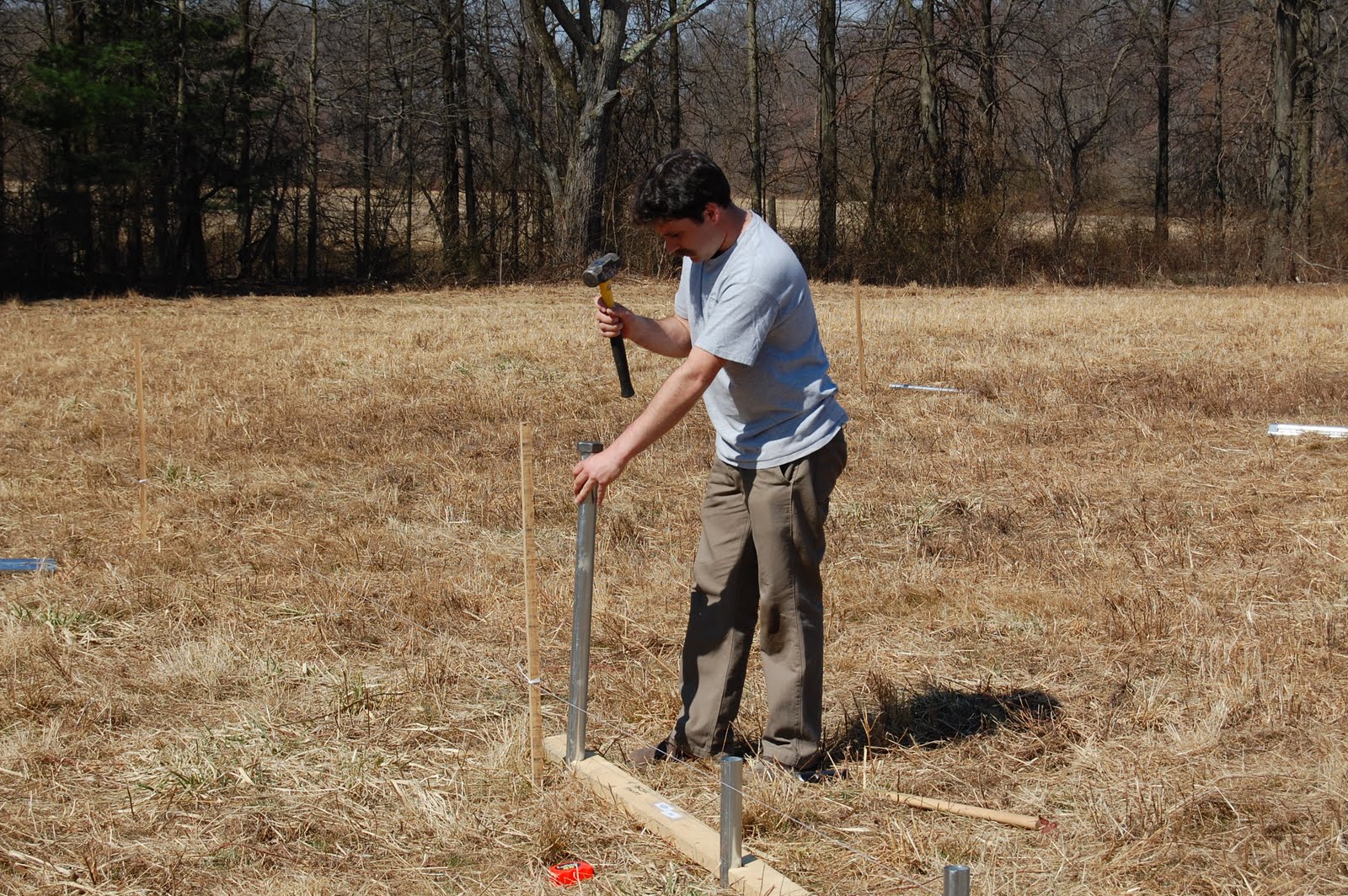
In the previous post it was mentioned that the posts needed to be hammered into the ground. This is that process. David is using a spacing board that was sent by the manufacturer of the greenhouse. This ensures that the posts are evenly spaced.


Also mentioned previously was that the hoops came in three parts and had to be assembled. Here are the pieces of the hoops.


Here is the completed frame of the greenhouse. If you click on the picture to enlarge it you will see the cross bars running along the top, corner braces, and wood running along the bottom of the posts. This is all intended to provide support to the structure to help hold the greenhouse together.

In this picture David is digging a hole into which will be place a post. Four posts are embedded in the ground. 2x4 lumber will then be placed on top of the posts. These 2x4's provide the foundation upon which the end walls will be built. Along the ground you can see heavy duty landscaping fabric- this will suppress the growth of weeds.

Here you can see the frame one of the end walls. You can see the 2x4's along the bottom and how the top pieces are attached to the metal of the last hoop. You can also see rock that has been placed on top of the fabric. This was done to help, somewhat, level the ground.


After receiving assistance from Farmer Matt in framing one end wall, Farmer David is beginning the process of putting up the frame for the other end wall.


Having completed the second frame, the next step in the process was putting plywood onto the frame. In this picture David is using a reciprocating saw to cut off and round off the plywood. The shiny, metal object that you also see are vents that will open up when the heating unit and fan are in operation.


In this picture the end wall has been primed in preparation of being painted. Also, on the left side of the picture, about half way up you can see some wood that is running the length of the greenhouse. This will be used to help secure the plastic to the greenhouse.


And here you can see the truly green, greenhouse. You can also see the fan that will be used to help with both the heating and the cooling of the greenhouse, depending on what is needed. You can also see that the door has been put in place. In some ways getting the door situated so that it would close and stay latched was one of the more frustrating aspects of the entire process.

Here it is, one greenhouse. Actually, at this stage there are still a number of tasks yet to be completed, but you have a general sense of what the finished project looks like.


Here is a picture of the interior of the greenhouse.


In this shot David, with the help of Farmer Dean (he no longer farms, but once a farmer, always a farmer), is beginning the first of various final stages. Here he is putting on pieces of wood that will help hold the plastic on the end walls.


Putting the greenhouse up was a long and arduous process. Actually, the notion of long and arduous sums up most aspects of the life and lifestyle of a farmer. To be a farmer, in particular a small scale, independent family farmer requires commitment, dedication, and a love for what you are doing. It's been said here before, and will be said again, when you go to a farmers' market take the time to get to know the farmer you are buying from. Ask them questions about the food you are buying. And remember to thank them.

Peace, hopefulness, and healthy eating to all.