The early part of the season is marked by seeding, seeding, seeding and more seeding. Seeding is repetitive. It can seem boring (actually at times it is boring). Whoever, there is a certain meditative aspect to seeding. You concentrate on the specific task at hand, you pay attention to what you are doing and only what you are doing. This is a concept called mindfulness and it is applicable in many ways. An athlete might call it being in the zone. In seeding, if you think about all the seeds and all the flats it can be overwhelming. If you concentrate on one seed, one flat at a time you move Further along.
The soil mix. Each farmer has their own recipe and if you are interested you can find proportions and ingredients on-line. If you farm organically you need to make sure that your mix has the right balance of ingredients to provide the seed the nutrients it needs to not only germinate but also to thrive. David uses a mix of peat moss, compost, blood meal, bone meal, greensand, limestone, purlite, and vermiculite. After three days of seeding we are on the fifth batch of mix.
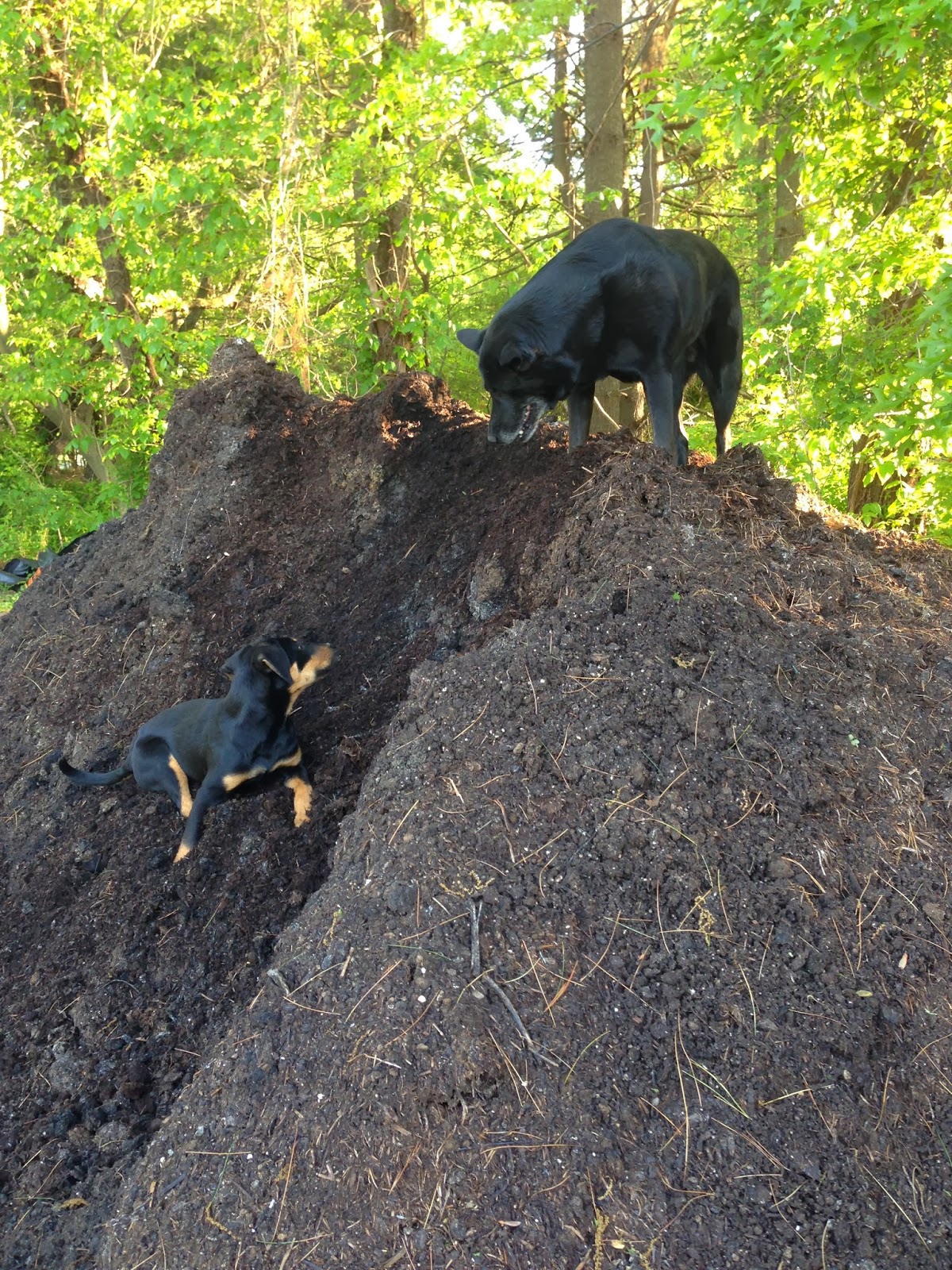
Hule and Ernie continue to be best buddies. Ernie, at one year, continues to be energetic with Hule, who is now 10. He continuously badgers Hule until she relents and plays with him. They provide us with a great deal of enjoyment. Ernie is the best thing that could have happened to Hule this past year.
If you go back to the previous post you can compare the pictures to see how much more seeding has been done. More onions were seeded on 3/15. Today, 3/16, Swiss chard, broccoli, cabbage, fennel, and beets were seeded. Tomorrow seeding will continue. The caveat to this is that the forecast calls for snow.
In the spirit of St. Patrick's Day, here's a toast to a warming trend in the weather.
Think Spring!!!
Sunday, March 16, 2014
Saturday, March 15, 2014
Here Comes Yet Another Farm Season
Here comes a new dawn, here comes a new day
Tune up start to play, just like any other day.
Can't stop, can't be late, mustn't make the people wait.
Can't even comb my hair or even change my underwear
Last year cleaning of seeding flats took place on March 5 and seeding started on March 12. This year the weather outside has been frightful and there was a burst pipe on the well tank. The well was fixed and some flats were washed on March 11. Seeding was going to start on March 12, but the forecast for March 13 was below freezing and it was not worth the propane to heat the greenhouse. Instead seeding started on March 14 with some scallions and onions. Seeding scallions and onions is very time consuming. With scallions 8 seeds go into each cell; 5 seeds per cell for the onions. Most other varieties of vegetables are usually 1 seed per cell, with some being 2 or 3. Thus, if you do nine flats of a variety of scallion it takes a great deal of time.
In the preceding months planning for the coming year has been taking place. What new varieties of plants to grow. What seed companies to buy the seeds. Planning the layout and organization of the fields in terms of crop rotation and which part of the field to have lie fallow. With these tasks complete, the seeding has started. Now, if the weather would just warm up and give the soil a chance to dry out the various farmers in this area, and elsewhere, will be very happy.
These are the flats of scallions and onions that were seeded on March 14.
This gives perspective on the size of the green house. Within three weeks it should be full.
The start of seeding means that the start of plowing, planting, weeding, harvesting, marketing, and complaining about the weather (oh, that's already started) is right around the corner. This is an exciting time of the season. Looking forward to seeing you at the farm and at markets.
Healthy eating to one and all. Support your local farmers. Support sustainable agriculture. Support organic farming.
Tune up start to play, just like any other day.
Can't stop, can't be late, mustn't make the people wait.
Can't even comb my hair or even change my underwear
Last year cleaning of seeding flats took place on March 5 and seeding started on March 12. This year the weather outside has been frightful and there was a burst pipe on the well tank. The well was fixed and some flats were washed on March 11. Seeding was going to start on March 12, but the forecast for March 13 was below freezing and it was not worth the propane to heat the greenhouse. Instead seeding started on March 14 with some scallions and onions. Seeding scallions and onions is very time consuming. With scallions 8 seeds go into each cell; 5 seeds per cell for the onions. Most other varieties of vegetables are usually 1 seed per cell, with some being 2 or 3. Thus, if you do nine flats of a variety of scallion it takes a great deal of time.
In the preceding months planning for the coming year has been taking place. What new varieties of plants to grow. What seed companies to buy the seeds. Planning the layout and organization of the fields in terms of crop rotation and which part of the field to have lie fallow. With these tasks complete, the seeding has started. Now, if the weather would just warm up and give the soil a chance to dry out the various farmers in this area, and elsewhere, will be very happy.
These are the flats of scallions and onions that were seeded on March 14.
This gives perspective on the size of the green house. Within three weeks it should be full.
The start of seeding means that the start of plowing, planting, weeding, harvesting, marketing, and complaining about the weather (oh, that's already started) is right around the corner. This is an exciting time of the season. Looking forward to seeing you at the farm and at markets.
Healthy eating to one and all. Support your local farmers. Support sustainable agriculture. Support organic farming.
Saturday, March 8, 2014
To Market To Market
For farm season 2013 Z Food Farm sold its produce at the Rittenhouse Square Farmers' Market in Philadelphia, at a weekday market in Summit NJ, at the farm on Wed. and Fri., and at four special New Amsterdam Markets in NYC (more about these markets later). In addition to the markets
Z Food Farm expanded the size of its CSA. CSA stands for Community Supported Agriculture. A CSA is where people buy a share in a farm at the beginning of the season. Then, over the course of the season, receive a weekly bounty of produce. The value of the bounty well exceeds the amount of money that the person pays up front. For the customers this is clearly a value. For the farmer it provides cash up front to cover their expenses at the beginning of the year before income starts to come in through the market sales. In addition to the traditional model of CSA, where the farmer provides specific items on any given week, Z Food Farm has a market share model. In this model members buy 'store credit' and receive added value to their share. For example, if a customer buys a $250 market share they receive $280 worth of credit. The benefit of the farm share model is that people receive a greater value for their investment. The benefit of the market share model is that people can pick and choose what they get on any particular visit to the farm. Farm share members will need to come, or send someone if they can't make it, to receive their share. Market share members can come once a week, twice a week, or whenever they choose. Some of the produce sold at market is harvested the day of the market. Clearly harvesting can't be done on Saturday for the Rittenhouse Market, but the produce is harvested Thursday afternoon and Friday. Thus everything that is provided is as fresh as possible. With this as background, here are a few pictures of this years markets.
Jerusalem Artichoke, also known as sunchoke (due to the plants stems and flower looking similar to a sunflower), is a tuber that stores inulin rather than starch. This makes it a useful alternative for people with diabetes. It is very versatile as it can be used in as many ways as you would use a potato- thinly slice and fry, make into a soup, boil, roast in the oven. This was the first year that David grew it and it proved to be a popular item. People who were familiar with them were very happy to see them. People who were new to them and tried them were more often than not happy to have tried them and bought more at future markets.
A sad sight- as mentioned in a previous post the tractor had a broken clutch and was out of service for close to five weeks. Though it rained most of the time the tractor was gone, its absence, combined with the rain, led to a domino effect of problems. Sigh
During farm season 2011 and 2012 Z Food Farm participated at the New Amsterdam Market in NYC. The market was located in front of the old Fulton Fish Market building on the lower East Side. Sadly, and for multiple reasons, the market this year was essentially discontinued. There was a special June market and then one market a month for September, October, November, and December. Z Food Farm participated in all markets except for the December market. At this time the future of the market is unknown. For information about the history of the market, the vision for the future of the market and surrounding area, and some of the current obstacles to the future of the market go to http://www.newamsterdammarket.org/ .
Summit NJ has had a Sunday farmers' market for quite some time. It is a very successful market as the community of Summit has shown great support for all vendors and for farmers bringing their fresh produce. This year the market managers decided to start a Thursday afternoon market to supplement and compliment the Sunday market. The underlying belief was that people would be have an opportunity to procure either produce or some other items that they might otherwise not be able to obtain until Sunday. The theory of the market was good, but the market was not successful. Though it was located near the train station, the market did not generate the foot traffic necessary for the market to be successful. The people who came were happy that the market was there as they were able to get what they had run out of following their shopping at the Sunday market; exactly what the market was hoping for. Unfortunately, not enough people attended the market. At the time of this writing the future of this market is in doubt.
Some of the produce available at market. The shishito peppers are generally found in restaurants where they are served as a tapas. The shishito is a Japanese pepper that is intended to be sauteed whole in olive oil to the point of starting to blister and turn brown. For those who are inclined, garlic can be added just as blistering commences and cooked just to the point where the garlic is done. You can then sprinkle on a little sea salt and then eat. The flavor will have gone from a basic green sweet pepper flavor to something totally different and difficult to explain and describe. However, without exaggeration, the flavor of them when cooked is amazing.
Another picture from one of the New Amsterdam markets.
Another new item for Z Food Farm for 2013 was purple sweet potatoes. David grew them an experiment and they were a huge hit. They are a deep purple inside and when cooked seem to get even darker. When cooked they have a creamy, almost fudge like texture, and are extremely flavorful.
Another new item was Chinese celery. Both the stalks and leaves are used, and they are best used in a stir-fry, soup, or a saute. The taste is stronger than regular celery and if used in a salad starting with a small amount would be best.
One more scene from the New Amsterdam Market. This picture was from the October market and shows quite a bit of diversity.
As of today, March 8 the start of the season is close at hand. Hopefully the snow storms are at an end and that warmer weather will help melt the remaining snow and start to dry out the soil to help make it safe to plow. Seeding will start as soon as soon as the well tank is repaired. Yes, the season is starting off with something in need of repair. Sigh.
The other hope is that this year will be drier than last. Considering that there was record rainfall for June and near record rain for July, it is bound to be somewhat drier. Here's hoping that it will be dry enough to let all of the local farmers get their seasons off to a rousing and successful start.
Fun cooking to all.
Thursday, February 13, 2014
For What It's Worth
One of the benefits (yes, benefits) of the frigid weather that we've been having, is that various bugs that cause significant damage to crops, as well as trees, will not survive. It is doubtful that any particular variety of bug will be wiped out, but the weather will put a dent in their population. An article in the New York Times, 'Celebrating Deep Freeze, Insect Experts See a Chance to Kill Off Invasive Species', provides more details about this. (http://www.nytimes.com/2014/01/09/nyregion/experts-cheer-the-deep-freeze-as-a-killer-of-invasive-insects.html) While the article is about trees, the basic premise is applicable to organic and conventional farmers. Considering that organic farmers have less resources to combat pests, the extreme cold weather that this area has experienced will be helpful.
Prior to the start of farm season 2013 David received a grant to purchase a high tunnel for the field. A high tunnel is a green house without a heater. The greenhouse, see the earliest posts for pictures of its construction, is where the plants germinate in a warm and controlled environment. A field high tunnel, though not heated, does provide the plants inside to grow in a more controlled environment than they would have in the feild. When the sides are rolled down the inside of the high tunnel provides a few degrees of added warmth. The advantage of this is that certain plants can be planted earlier in the season and others can last longer at the end of the season. The following pictures provides a partial chronicle of the building of the high tunnel.
Building the green house required more precision, but even with the high tunnel the posts needed to be aligned and pounded into the soil to a particular depth. The posts for the green house were only a couple of feet long and we were able to use a mallet to push them into the soil. Clearly with longer posts using a mallet was not practical. This picture shows David using the front end loader to pound the posts into the ground. As everything, things did not go as smoothly as hoped- there were some rocks beneath the surface that prevented the posts from going to the desired depth. A sawzall, a toll with a reciprocating blade that cuts through metal, was needed to trim the posts to size. Prior to this step measurements were made to make sure, as best as possible, that the posts were going to be the proper distance apart. All in all, very time consuming.
Once the posts were in the ground, the 'hoops' had to be place on top of the jutting posts. If not properly spaced getting the 'hoops' in place was most difficult. Even when everything was correctly aligned, it was a challenging process. The picture below shows David clamping the 'hoop' to the cross beam. This helps to provide stability to the entire structure.
Another step in providing the high tunnel with stability was bolting the wood to the posts. There were pre-cut holes in the posts, but we needed to cut through the wood and then push the bolt through the hole and then use a nut to secure the post to the wood. This was done on the bottom as well as along the side. While not technically difficult, the process of doing this is far more time consuming than you would imagine.
The first picture shows the inside of the high tunnel. The second shows the beds that have been made with plastic row cover. On the green house there are wooden walls on the front and back. On the high tunnel plastic is attached to the ends and can be rolled down and up as the weather dictates.
The completed high tunnel.
Beds waiting to be planted. Sadly, this was what David was unable to do as much as desired in the early part of the season due to the wet ground.
As mentioned in the first post in this current sequence, the walk-in cooler wasn't cooling. Needing to keep the harvest cool we used the coolers that are used to bring the produce to market. They are lined up this way, at a slight incline, to allow the melting water to flow out of the coolers. If the water staying in the cooler the produce would turn to mush in the water. Doing this on a daily basis was, to say the least, annoying.
The plan for farm season 2014 is to start seeding by the end of February. The list of things to do in anticipation of seeding is lengthy. Thus we need it to warm up a little bit and to stop snowing. Ah, my first complaint of the season about the weather. I would anticipate a few more before all is said and done.
Prior to the start of farm season 2013 David received a grant to purchase a high tunnel for the field. A high tunnel is a green house without a heater. The greenhouse, see the earliest posts for pictures of its construction, is where the plants germinate in a warm and controlled environment. A field high tunnel, though not heated, does provide the plants inside to grow in a more controlled environment than they would have in the feild. When the sides are rolled down the inside of the high tunnel provides a few degrees of added warmth. The advantage of this is that certain plants can be planted earlier in the season and others can last longer at the end of the season. The following pictures provides a partial chronicle of the building of the high tunnel.
Building the green house required more precision, but even with the high tunnel the posts needed to be aligned and pounded into the soil to a particular depth. The posts for the green house were only a couple of feet long and we were able to use a mallet to push them into the soil. Clearly with longer posts using a mallet was not practical. This picture shows David using the front end loader to pound the posts into the ground. As everything, things did not go as smoothly as hoped- there were some rocks beneath the surface that prevented the posts from going to the desired depth. A sawzall, a toll with a reciprocating blade that cuts through metal, was needed to trim the posts to size. Prior to this step measurements were made to make sure, as best as possible, that the posts were going to be the proper distance apart. All in all, very time consuming.
Once the posts were in the ground, the 'hoops' had to be place on top of the jutting posts. If not properly spaced getting the 'hoops' in place was most difficult. Even when everything was correctly aligned, it was a challenging process. The picture below shows David clamping the 'hoop' to the cross beam. This helps to provide stability to the entire structure.
Another step in providing the high tunnel with stability was bolting the wood to the posts. There were pre-cut holes in the posts, but we needed to cut through the wood and then push the bolt through the hole and then use a nut to secure the post to the wood. This was done on the bottom as well as along the side. While not technically difficult, the process of doing this is far more time consuming than you would imagine.
The first picture shows the inside of the high tunnel. The second shows the beds that have been made with plastic row cover. On the green house there are wooden walls on the front and back. On the high tunnel plastic is attached to the ends and can be rolled down and up as the weather dictates.
The completed high tunnel.
Beds waiting to be planted. Sadly, this was what David was unable to do as much as desired in the early part of the season due to the wet ground.
As mentioned in the first post in this current sequence, the walk-in cooler wasn't cooling. Needing to keep the harvest cool we used the coolers that are used to bring the produce to market. They are lined up this way, at a slight incline, to allow the melting water to flow out of the coolers. If the water staying in the cooler the produce would turn to mush in the water. Doing this on a daily basis was, to say the least, annoying.
The plan for farm season 2014 is to start seeding by the end of February. The list of things to do in anticipation of seeding is lengthy. Thus we need it to warm up a little bit and to stop snowing. Ah, my first complaint of the season about the weather. I would anticipate a few more before all is said and done.
Friday, January 24, 2014
Slow Food
Some variation of these pictures have been posted over the years. With that said, I think that some repetition is a good thing. While these pictures are posted long after the fact, you can look back fondly at the bounty you enjoyed from one local farmer or another this past year. And you can look forward to what is coming your way this coming season.
Pictured below is a variety of lettuce called Skyphos. It is a most delicious butterhead. It is very delicate and you are not likely to find it in a grocery store, even one that would carry more specialized types of produce. And it is gorgeous!
The bee hives at the farm continue to function. While no honey was harvested this season, the bees were busy doing their essential work of pollinating. For those not familiar with the issue, honey bees are in peril. Hives around the country have been dying in vast numbers. The cause of the die offs is not certain, but it does seem related to pesticides and herbicides. There is much information available if you want to read more about this topic. Remember, no bees, no food.
Here are various plants in their seeding trays. After seeding the plants germinate, start to grow, get moved outside (the following picture), and then get planted in the ground. As mentioned, the record rains of June, and near record rainfall in July, led to many plants staying in their seeding trays way to long. All farmers encounter problems similar to this, but small, sustainable, organic farmers are more vulnerable.
Here's a small sampling of some of the bounty that was brought to market.
For those who enjoy the simple joy of growing their own food, we have brought plants of various vegetables, tomatoes, basils, and herbs to market. If you are interested in growing your own we can provide you with fresh, healthy, and organic plants. If not from Z Food Farm, check with a local farmer near you. At a local farm you will have a better chance of getting a fresh, healthy plant to grow.
At ZFF the fields are covered with snow and the temperature is bitterly cold. However, the seed order is in the process of being developed and the plans are to start seeding towards the end of February. Cheers to the coming season!!
Pictured below is a variety of lettuce called Skyphos. It is a most delicious butterhead. It is very delicate and you are not likely to find it in a grocery store, even one that would carry more specialized types of produce. And it is gorgeous!
The bee hives at the farm continue to function. While no honey was harvested this season, the bees were busy doing their essential work of pollinating. For those not familiar with the issue, honey bees are in peril. Hives around the country have been dying in vast numbers. The cause of the die offs is not certain, but it does seem related to pesticides and herbicides. There is much information available if you want to read more about this topic. Remember, no bees, no food.
Here are various plants in their seeding trays. After seeding the plants germinate, start to grow, get moved outside (the following picture), and then get planted in the ground. As mentioned, the record rains of June, and near record rainfall in July, led to many plants staying in their seeding trays way to long. All farmers encounter problems similar to this, but small, sustainable, organic farmers are more vulnerable.
Here's a small sampling of some of the bounty that was brought to market.
For those who enjoy the simple joy of growing their own food, we have brought plants of various vegetables, tomatoes, basils, and herbs to market. If you are interested in growing your own we can provide you with fresh, healthy, and organic plants. If not from Z Food Farm, check with a local farmer near you. At a local farm you will have a better chance of getting a fresh, healthy plant to grow.
At ZFF the fields are covered with snow and the temperature is bitterly cold. However, the seed order is in the process of being developed and the plans are to start seeding towards the end of February. Cheers to the coming season!!
Sunday, January 19, 2014
Best Buddies
| Happy days and happy dogs. |
Saturday, January 18, 2014
This Was The Year That Was
Be
the ocean when it meets the sky
“greek freighters are dumping crap
somewhere right now"
be the magic in the northern lights
"the
ice is melting!"
be the river as it rolls along
"toxic waste dumpin' from
corporate farms"
be
the rain you remember fallin'
"be the rain, be the rain"
save
the planet for another day
"be the rain, be the rain"
be
the river as it rolls along
"be the rain, be the rain"
(Neil Young)
When this blog was started there were two main
purposes. One was to provide a general sense of what small farmers go through,
especially start up farmers. The other was to create a semblance of a written
history of David’s life as a farmer. This blog started in 2007 when he was the
farm manager at Gravity Hill Farm. This documentation has covered David’s three
years at Gravity Hill and now through four years running his own farm, Z Food
Farm. For various reasons there has been a lack of consistency in staying
current with events at the farm for season 4 (2013). There were a few posts early
on, but then there has been silence. This post is intended to be an end of the
year summary of farm season 2013. Cheers!
To borrow from Dickens, it was the best of times
it was the worst of times. (Actually, the full quote is pretty amazing; take a
moment and look it up.) While it is a stretch to compare the events of Dickens’
novel with a farm season, this was marked by a significant dichotomy between
the start of the season and the end of the season. The beginning of the season
was reflected the notion that if it could go wrong, it did go wrong. Starting late
July/the beginning of August, about the time tomatoes started coming to market,
circumstances took a turn for the better. From that time through the end of the
season the farm continued in a positive vein. Ultimately, despite the myriad of
problems during the first months, the season, as a whole can be viewed as
successful. That’s the broad overview. Here then are some of the specifics to
provide a synopsis of the year; for you to get a sense of the challenges that
all farmers face and for David to have some documentation to look back on so
that one year doesn’t fade into the next.
Heading into the season there were a couple of
minor things that David decided to have repaired on the tractor. The process of
this repair took about two weeks longer than anticipated. This delay prevented
David from doing initial field work- mowing the fields, tilling the soil, forming
beds. This delay reverberated throughout the season. While seeding started on
time, the first, and most subsequent plantings was delayed. This resulted in
some vegetables not getting planted and some not doing well once they were
planted having spent too much time in their seeding trays.
And then, once plants were in the ground, there
were the deer. Ah, the deer. Not dear deer. But those damn deer. The deer, at
the beginning of the year, ate the first plantings of beets, Swiss chard, and
lettuce. Thus, when markets started, those items were not available for sale.
While it is hard to guesstimate the actual cost of the damage, it is safe to say
that the deer had very expensive dinners at the expense of Z Food Farm. As a
reminder- Z Food Farm, as do many smaller, local farms, uses an electric fence
as a means of defense against the deer. (insert picture) The charge in the wires of
the fence is not enough to do any harm to the deer nor is the charge strong
enough to shock the deer if they touch the wires with their body. The way the
fence acts as a deterrent is to bait the fence with peanut butter, which is
intended to lure the deer to the wire. The goal is for the deer to lick or
sniff the peanut butter and to get a shock on their tongue or nose and thus
teach them that the fence is to be avoided; an example of operant conditioning.
While deer have been a problem in the past, this year was the worst. In
addition to making sure the fence was baited on a regular basis throughout the
season, David used row cover (which the deer tore through) and some netting
that is advertised as an effective means of keeping deer from eating crops. It
is hard to discern what, if anything, worked, but over the course of the season
deer damage was reduced. Please notice that I did not say ended. Hungry, hungry
deer. Angry, angry farmer.
Then there was the weather. All farmers are at the
mercy of the weather. Too hot. Too cold. Too wet. Too dry. Frequently checking
the forecast, not because there is anything that you can do about the weather
itself, but hoping that there are steps that can be taken to mitigate the
impact of the weather by knowing what is coming becomes a daily preoccupation. Sometimes
there are steps to be taken, and sometimes the weather gets the better of you.
The later of these two being the case this year. The month of June saw a record
rainfall for Mercer County. July was not too far off of that month’s record.
Though plants need water to survive, too much water is problematic for a number
of reasons. One is that if the soil is too wet it is not healthy for the soil
to do any tractor work. To be healthy, soil needs to ‘breath’. This condition
requires there to be spaces within the soil. These spaces allows the earthto
breath and to allow for life- insects and bugs that help maintain the arability
of the soil. Wet soil is easily
compacted by the weight of a tractor. When this occurs the soil is unable to
breath and the life within the soil is, for lack of a better word, squashed.
Thus when the soil is wet, small, sustainable, organic farmers, farmers who
have a love and respect for the land they are toiling, are unable/unwilling to
do tasks that require the use of their tractor. For David this led to his being
unable to form beds into which he would do his planting. By being unable to
form beds, seedlings that were ready to be planted had to wait in their seeding
trays until the beds were eventually formed. While there is a margin of error
for how long plants remain healthy if their planting is delayed, at a certain
point the delay becomes deadly. An example to illustrate this would be the
winter squash. Winter squash need to be planted in June. Due to the wet soil,
their planting was delayed some four to five weeks. By the time they were
planted the majority had died in their trays. Many more died shortly after
planting. The end result was that having had the best ever winter squash
harvest last year, this year’s harvest was the worst. Winter squash was not the
only crop that was impacted in this manner, but it is the most glaring.
Another specific example of the impact of rain is
on the health of the plants. In general, organic plants are more vulnerable to
disease than conventional crops. This is due to conventional farmers having
access to a variety of substances that can be sprayed on their crops to
prevent/minimize the affects of plant diseases. While the organic farmer does
have some items that can be used, they are not nearly as effective. In this
context wet and windy conditions help to spread a variety of diseases. Thus,
even those plants that were planted on time, or only a little late, did not
produce as they otherwise could have. This led to problems with cucumbers, the
second planting of summer squash, and sweet peppers and eggplants. In other
words, the beginning of the season (June and July) was marked by an unusual
number of challenges and frustrations. The problems resulting from excessive
rain impacted all of the small farmers in the area, but not being alone does
not lessen the frustrations that any one farmer experiences. In the midst of
all the rain, there was one additional situation that made circumstances even
more problematic.
As mentioned earlier, David had some maintenance
done of the tractor and that this took longer than expected. During the time of
rain, the clutch on the tractor broke. While the ground was wet during part of
this time, there were windows of opportunity that David was unable to take
advantage of due to his not having his tractor. While David was able to borrow
a tractor (thanks Matt), the damage had been done. By the time David got his
tractor back there were many tasks that were backed up. The priority was on
forming beds in order to plant. And despite working dawn to dusk some tasks
remained on the waiting list throughout the season.
One last tale of frustration- the air conditioner
for the walk-in cooler broke. Well, without a cooler it is hard to keep your
produce fresh. Fortunately we already had a large number of coolers, they are
what David uses to bring his produce to market. However, in order to keep the
produce cool enough in the coolers we had to use ice in the coolers. Without
going into the specifics, it took a couple of weeks before the walk-in was back
up and running. That required a lot of ice. If you want to know the best place
to purchase ice, the least expensive place, let us know and we’ll be happy to
tell you.
There were various other trials and tribulations,
but you get the general idea. Throughout this period there were circumstances
that provided opportunity for gratitude and hopefulness. In this vein some
thanks are in order. Thanks to the CSA members of the farm. Your patience,
understanding, and words of support and encouragement gave David an emotional
boost to keep pushing forward. Speaking for myself, as the one who does the
farm market and gets to see the members on a weekly basis, I enjoyed spending
some time with all of you and getting to know you within the structure of the
market. Thank you so very much.
Thanks to our customers both at the farm and in
Philadelphia at the Rittenhouse Square Farmers’ Market. As consumers there are
many choices available as to where to purchase your produce. That you choose to
do some of your shopping at Z Food Farm is not taken for granted. (This notion
also is applicable for the CSA members.) The goal of David is to provide you
with a high quality product. That we see so many of you on a weekly basis provides
a sense of acknowledgement that we are doing at least a satisfactory job.
Thanks to Karel. Yes, we know that you appreciate David
for the assistance that he provided to you for your project, but your
friendship and handiness eased some of the stress. Not just the stress related
to the big problems, but the stress that comes from the day in and day out
factors associated with farming even in the best of times.
Thanks to Farmer Matt who through the years has
continued to provide David with practical support in the form of loaning
various pieces of equipment. Most importantly thanks for being a friend.
Well, this is rather lengthy. Trust me, it could
be longer. As mentioned earlier, this is for the reader who has an interest in
what goes into farming. While this is of value to whomever might read this, for
me the value of is a documentation of what took place, a historical record.
With this in mind, some steps are being taken in
preparation for the coming season. An inventory has been completed of seeds
leftover from the past season. Also, David is scouring the various seed
catalogs looking for new things to grow. Hopefully you enjoyed some of the new
things that were offered this year, such as the purple sweet potatoes and the
Jerusalem artichokes. The goal for next year is to continue with tried and true
and the new and different.
Note- within the next couple of days some pictures
will be posted to show some of what took place. (I promise!!)
Support local farms. Support sustainable farms.
Support organic farms. To one and all, happy and healthy eating.
Subscribe to:
Posts (Atom)