Sunday, June 6, 2010

Bees and Market

Since last time a great deal has been taking place at Z Food Farm. Prior to providing an update on various events there is an issue of importance to mention- Bees. Over the course of the past few years there have been reports about a collapse in bee colonies in the United States. To quote from an article, written by Alison Benjamin, that was posted on Alternet.org- "Disturbing evidence that honeybees are in terminal decline has emerged from the United States where, for the fourth year in a row, more than a third of colonies have failed to survive the winter." Considering the significant importance of bees to the cycle of farming and bring food to your table this is an issue that can not be overlooked. To read the full article go to- http://www.alternet.org/story/146701/ At this time Z Food Farm is now home to five bee hives. One is left over from last year. One is a 'rescue' hive- bees were swarming at a construction site and were close to being 'forcibly' removed. Through the intervention of someone who knew that David's friend Gab had an interest in bees, David was brought in to constructively move the bees to a safe location, Z Food Farm. At this time the hive is doing well. And there are three hives that belong to a new friend of Z Food Farm, Frank. Frank has a strong passion and commitment to bees and in addition to caring for his hives has been a valued asset in helping to tend to the needs of David's two hives. He is a good do-bee (a reference to those old enough to remember Romper Room). Here are some pictures showing the bees being buzzy.


It is not too much of a stretch to say, no bees, no food.

Jumping ahead of some events, today, June 6, was a new first for Z Food Farm- the first farmers' market. And it was only appropriate that David's first market was at the Lawrenceville Farmers' Market since that is the market David has been at for the past five years. As previously mentioned, getting the farm operation up and running took longer than anticipated. Building the greenhouse and putting up the deer fence delayed both the seeding of new plants and then the planting of those plants. The meaning of this is that David is running behind in his having produce available for sale at market. But, not to be deterred, David did have potted tomatoes, lettuce, basil, other herbs, and Swiss Chard plus garlic scapes available for sale. It was great to renew contact with customers (friends) who have been buying produce from David over the past few years and to make new customers (friends). Markets provide David, and other farmers, the opportunity to showcase the fruits (the vegetables) of their labor of love. In addition to selling at the Lawrenceville Market this year (Sundays, 9-2), Z Food Farm will be selling its produce at two other locations- Saturdays at Rittenhouse Square in Philadelphia (Rittenhouse Farmers' Market Hours: 9:30 am to 3 pm. Location: Walnut Street (south sidewalk), west of 18th Street) and Wednesdays at Z Food Farm!!! (Noon to 7). Go to www.zfoodfarm.com for directions). Sales at the farm will officially start Wednesday, June 16. The date that Z Food Farm will make its initial appearance at the Rittenhouse Square Market will be announced as soon as that decision is made.

Here are pictures from Z Food Farms first market day.

The truck is loaded and ready to go.


All is ready and good to go.


The inaugural debut of Z Food Farm. The sign is not the final version of the farm logo. To the left of the sign you can see some of the lettuce. To the right of the sign, lying on the table, are the garlic scapes. (Scapes are the foliage that grows from the bulb of garlic as it grows under the surface of the ground. The taste of scapes is milder and more mellow than garlic; saute them up with just about anything you can think of.


Tomatoes, tomatoes, and more tomatoes. If you are going to grow your own tomatoes, it is strongly encouraged that you purchase your plants from a local farmer. Not to disparage large commercial sellers, buying local enhances the odds that you are getting a plant that is in good health and free of disease. This can't be guaranteed, but it is increasing your odds. Local conventional is better than box stores. Local organic is better yet. Not sure what you want, you'll get better answers from the farmer growing the tomatoes than you will from someone at a box store. And if you have any questions as your plant is growing you can stay in touch with the farmer who sold you the plant. Purrrfect!!


Let-uce help you pick the specific type of lettuce you would like to grow. When you buy plants or produce at your favorite local farmers' market you have the opportunity to try new varieties of all sorts of produce, including lettuce and tomatoes.


Yes, you too can grow your very own Swiss Chard in your home garden. Swiss Chard is one of those leafy veggies that are wonderfully healthy for you.


Herbs- chives, spearmint, lemon verbena, basil, lemon thyme. Again, growing your own can be great fun. If you have a dehydrator you can grow your own herbs, dry them, and enjoy your very own herbs throughout the year.


That's it for now. Regardless of where you live I'm confident that you can find a farmers' market nearby. This is the time of year when you can purchase your veggies locally and have them fresh to your table from the nearby field from whence they came. While Z Food Farm will be certified organic (David is in the process of obtaining his certification), if organic isn't of critical importance to you, please still make the effort to shop a the local farmers' market close to you. Today, more than has occurred for a long time, the consumer has more alternative options in where to purchase their produce. Conventional local is great. Conventional organic is even better.

Good health and good eating to one and all.

Tuesday, May 25, 2010

Further

Further- a sense of always moving forward. Further- accepting obstacles as part of the process and not letting them get in your way. Further- knowing that there are places to be, but being part of the process in the moment. Further- accepting too much rain/too little rain. Further- accepting bugs and beasts that strive to eat what you are growing. Further- persevering regardless. Further- loving what you do, doing what you love.

Farmers have to live in the moment. On a daily basis there is much that needs to be accomplished and it seems that no matter how much time is allotted a particular task, that task always takes longer than anticipated. Think something is going to take an hour, anticipate a glitch and plan for two hours and then the task takes three. And on and on. A flat tire. Mice eating seeds. A broken belt on a lawn mower. A mistake on the electric bill. Reports of late blight already being seen along the East Coast. Why do 'old timers' stay in farming? Why do 'newbies' get into farming? A sense of commitment to the soil. A feeling of passion for the act of making things grow. The feeling of joy upon seeing a seed start to germinate. The sense of oneness with nature. The sense of satisfaction of succeeding in spite of the obstacles. All farmers experience these feelings. The smaller the operation the more personal the relationship the farmer has with the land. To succeed in farming there needs to be a complete and total commitment to the ongoing process of the tasks at hand, regardless of obstacles.

May 12 marked a milestone day at Z Food Farm- it was the first day of planting. The honor of being the first crop into the ground was, drum roll, ............ potatoes!! Since then lettuce, beets, kale, Swiss Chard, salad mix, carrots, summer squash, and on and on have been planted. Farmer David, with the help of his crew of paid workers and volunteers, has been busily trying to catch up having been delayed in getting everything moving further along. In terms of staff there is Gregg the intern and Oscar the hourly farm hand; both are young men and both are extremely diligent in their efforts. They are friendly, personable, and committed to helping make Z Food Farm a great success. David is fortunate to have both of them. David has also benefited from the assistance of volunteers. Old friends helping out include Mary Jo and Malaika- much thanks to them for their assistance. One new friend is Anthony who has helped out a few times with seeding, table building, and planting. To date the most consistent helper has been Angela. She has been coming on a weekly basis since shortly after the farm was up and running. Much thanks and gratitude to all who are involved in helping to make Z Food Farm a great success. (Pictures of staff and volunteers will appear shortly on this blog. There are a couple pictures on the web site. Sorry to be running behind on this and other items of interest.)

Following are some other bits of news about the happenings at the farm.

Here David is using Farmer Matt's tractor and roto tiller. The roto tiller breaks up the soil to enable the farmer to next form beds into which either seeds will be directly sowed or plants planted.


Here David is using Farmer Matt's plant bed former and plastic layer. The discs along the side of the attachment help form the beds and lays down both the plastic mulch and the drip tape. Black plastic keeps in more heat and provides some of the crops with needed added warmth. Regardless of color the mulch is intended to aid in weed suppression.


An organized farmer is a happy farmer. Part of the process is knowing where your tools of the trade are 'living'. Organization of tools, seeds, and supplies is of critical importance.


With mom making use of Craig's list, David was able to obtain this lawn mower. Sadly, it now has a flat tire and a frayed belt. It has been used extensively; probably excessively. But it sure did a good job.


Not sure what the official name of this is, but it will be called the post thumper. It was used to put all of the posts for the deer fence into the ground. By hand it would have taken hours/days to dig all the post holes by hand (some 80 posts). In about four hours David, with the help of Lee Hendrickson, whose machine this is, was able to put all of the posts into the ground in about four hours. At the front end is a hydraulic 'thumper' into which the post is placed and then pounded into the ground. What a wonderful time saver.
And here are the posts. Along the side of the posts, which surrounds the field, as you can easily see in the front post conductors. There are seven on each post. Seven strands of wire were then placed around the field, attached to the posts by the conductors. The wires are then electrified with the goal being to keep deer out of the fields. The purpose of farming is to grow vegetables to bring to the people, not to feed the deer.


To borrow from Simon and Garfunkle, it's all happening at the farm, I do believe it, I do believe it's true. Markets are right around the corner. Hope to see you there soon.

Peace and good eating to all.

Sunday, May 9, 2010

Building Tables

"Architects may come, and architects may go, and never change your point of view. When I run dry I stop awhile and think of you."

In previous posts you've seen the seeding trays resting on 'tables'. While these tables do not need an architects expertise to design and build, they do need to get built. The following pictures will show how this is accomplished.


Step 1. First you need lumber. In this case the frame is made of 2x3 studs, 8 feet in length. The goal is to find pieces of wood that are as straight as possible. This is not as easy a task as you might imagine. For every piece of wood that was selected at least 5, if not more, were rejected. David is using 2x3's to make the tables lighter in weight. They are held together using deckmate screws. Clamps made screwing the pieces of wood together much simpler than using one's hands. Notice that produce crates make a great work table. Farmers are very resourceful at using what is at hand.

Step 2. After the outside frame has been assembled a 2x3 stud is connected to provide strength and support. Again, clamps are used to hold the wood in place as the screws are inserted. At the top of the photo you can see the clamp holding the wood in place. In the right front of the picture, on the produce crate you can also see the clamp.


Step 3. Again using 2x3 pieces of wood, support braces are screwed into place. The top picture shows one brace being put into place. The second picture shows all four braces in place. As with the center brace, the purpose of these braces is to provide stability and strength to the table as a whole.


Step 4. Additional support braces are placed the length of the table. For this step 1x2 pieces of wood were used. As with the 2x3's finding straight pieces of wood is important and was quite challenging. It took about ten pieces of wood to find one usable piece. These braces do not lend much to the overall stability of the table itself. It will provide support for the wire that will now be stapled onto the completed frame of the table. To assemble this frame takes approximately one hour.

Step 5. Here is David using a staple gun to stable the wire onto frame of the table. At the top of the table is the roll of wire that is used. Chicken mesh wire is then stapled over this wire. This allows for a more stable surface on which to place the seeding flats. In the second photo you can see the completed table. It takes approximately 30 minutes to staple both pieces of wiring to the table.


And there you have it. At this time there are currently 29 completed tables. Most of them will be place in the greenhouse. The rest will stay outside the greenhouse where plants will go to be 'conditioned' prior to going into the field. (More about this in a future post.)


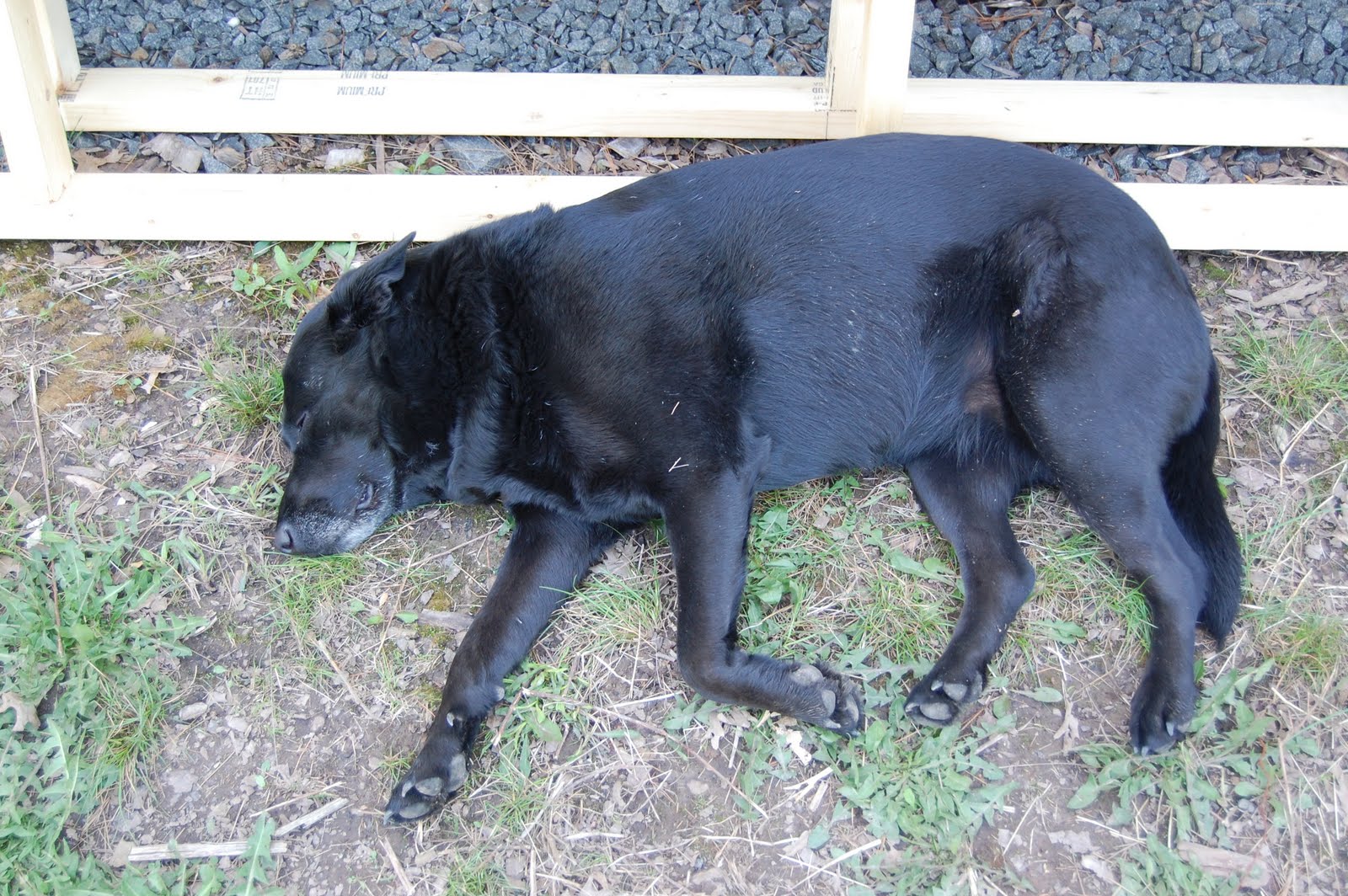
The dog days of summer. Here Hule is resting under a tree escaping the oppressive summer heat. Oops! It is only the first week of May. Hmmm? What does that imply about how the summer weather is going to be?


Things are moving along at Z Food Farm but much work remains to be done. Stay tuned for ongoing updates. And don't forget to check out the website (www.zfoodfarm.com). The site is still in its developmental stages but should be up to date by the beginning of June. Until next time, peace and healthy eating to all.
Friday, April 23, 2010

Fixing a Hole Where the Rain Gets In

"I'm fixing a hole where the rain gets in and stops my mind from wandering, where it will go. I'm filling the cracks that ran through the door and kept my mind from wandering, where it will go."

The greenhouse is an essential component of a farm. It is where the newly seeded plants are placed and where they will germinate and begin to sprout. The greenhouse provides a warm and secure environment for the newly developing plants. Though certain crops are directly seeded into the soil in prepared beds, most plants start their life in a greenhouse. In addition to protection from the elements, in the greenhouse the farmer can control how much water the plants will receive. The greenhouse provides the new plants with the warmth that enhances their growth and development. As a new farm, Z Food Farm needed a greenhouse. Over the course of a couple of weeks, and with help from Farmer Matt, David erected his greenhouse. A few pictures were presented in the previous posting. In this post are pictures showing the process of building the greenhouse.

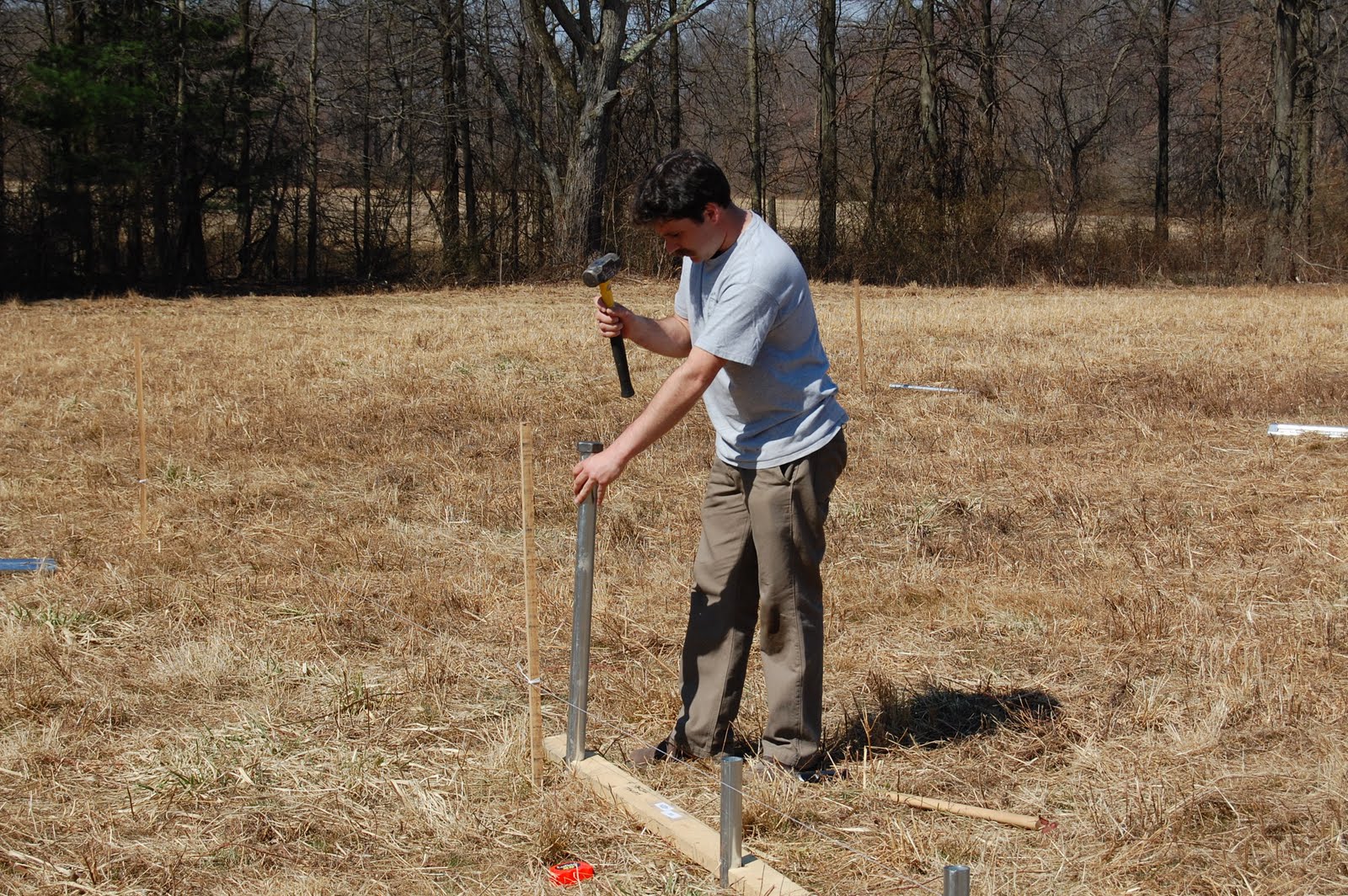
In the previous post it was mentioned that the posts needed to be hammered into the ground. This is that process. David is using a spacing board that was sent by the manufacturer of the greenhouse. This ensures that the posts are evenly spaced.


Also mentioned previously was that the hoops came in three parts and had to be assembled. Here are the pieces of the hoops.


Here is the completed frame of the greenhouse. If you click on the picture to enlarge it you will see the cross bars running along the top, corner braces, and wood running along the bottom of the posts. This is all intended to provide support to the structure to help hold the greenhouse together.

In this picture David is digging a hole into which will be place a post. Four posts are embedded in the ground. 2x4 lumber will then be placed on top of the posts. These 2x4's provide the foundation upon which the end walls will be built. Along the ground you can see heavy duty landscaping fabric- this will suppress the growth of weeds.

Here you can see the frame one of the end walls. You can see the 2x4's along the bottom and how the top pieces are attached to the metal of the last hoop. You can also see rock that has been placed on top of the fabric. This was done to help, somewhat, level the ground.


After receiving assistance from Farmer Matt in framing one end wall, Farmer David is beginning the process of putting up the frame for the other end wall.


Having completed the second frame, the next step in the process was putting plywood onto the frame. In this picture David is using a reciprocating saw to cut off and round off the plywood. The shiny, metal object that you also see are vents that will open up when the heating unit and fan are in operation.


In this picture the end wall has been primed in preparation of being painted. Also, on the left side of the picture, about half way up you can see some wood that is running the length of the greenhouse. This will be used to help secure the plastic to the greenhouse.


And here you can see the truly green, greenhouse. You can also see the fan that will be used to help with both the heating and the cooling of the greenhouse, depending on what is needed. You can also see that the door has been put in place. In some ways getting the door situated so that it would close and stay latched was one of the more frustrating aspects of the entire process.

Here it is, one greenhouse. Actually, at this stage there are still a number of tasks yet to be completed, but you have a general sense of what the finished project looks like.


Here is a picture of the interior of the greenhouse.


In this shot David, with the help of Farmer Dean (he no longer farms, but once a farmer, always a farmer), is beginning the first of various final stages. Here he is putting on pieces of wood that will help hold the plastic on the end walls.


Putting the greenhouse up was a long and arduous process. Actually, the notion of long and arduous sums up most aspects of the life and lifestyle of a farmer. To be a farmer, in particular a small scale, independent family farmer requires commitment, dedication, and a love for what you are doing. It's been said here before, and will be said again, when you go to a farmers' market take the time to get to know the farmer you are buying from. Ask them questions about the food you are buying. And remember to thank them.

Peace, hopefulness, and healthy eating to all.

Saturday, April 17, 2010

GETTIN' THERE

"Well there's just a little bit of magic in the country, music we're singin' so let's begin. We're bringin' you back down home where the folks are happy. Sittin', pickin', and a-grinnin' casually, you and me. We'll pick up the pieces, uh huh."

Since the last post a great deal has been taking place at Z Food Farm. There will be time to sit and sing later on, but for now Farmer David is more putting the pieces together rather than picking up the pieces. This point was mentioned in the previous post, but the truth of the matter is that despite how much time David has allowed himself to get things done, such as putting together the greenhouse, things still take longer than anticipated. But day by day David is gettin' there. One important item to mention is that the website is, sort of, up and running. 'Sort of'- the site is still a work in progress with much yet to do (there is an ongoing theme here). Thanks to David's friend Gab, with assistance from brother Peter, for getting the site moving towards excellence. To visit the site go to www.zfoodfarm.com.

The following is paraphrased from the book "Bringing It To The Table", by Wendell Berry- "People live for quitting time, for weekends, for vacations, and for retirement. One works not because the work is necessary, valuable, useful to a desirable end, or because one loves to do it, but only to be able to quit. This is explained, of course, by the dullness of the work, by the loss of responsibility for, or credit for, or knowledge of the thing made." The reader can decide for them self the extent to which this statement is true for them. For Farmer David, and the farmers within his local farming community, as well most small family farmers, this is simply not the case. Small farmers, and even some who are part of the large agri business farm system, couldn't do what they do if they did not have a passion and commitment to what they do. For the most part 'quitting time' for a farmer is when the sun goes down and there is very little that is dull about the process of farming. When you go to your local farmers' market, get to know the farmer and learn about their love for what they do. Peace, happiness, hopefulness, and healthy eating to all.

And now to bring you a little up to date with some of what's been going on at Z Food Farm.

It might be a little thing, but appearances are important. On the left is the before, on the right is the after. The color of the newly painted door is Miso.


Greenhouse construction- Part 1: The first step in constructing the greenhouse is to pound the posts into the ground, in as straight a line as possible and to as an equal depth as possible. A surveyors transit is used to get the posts to the same height, relative to the level of the ground.

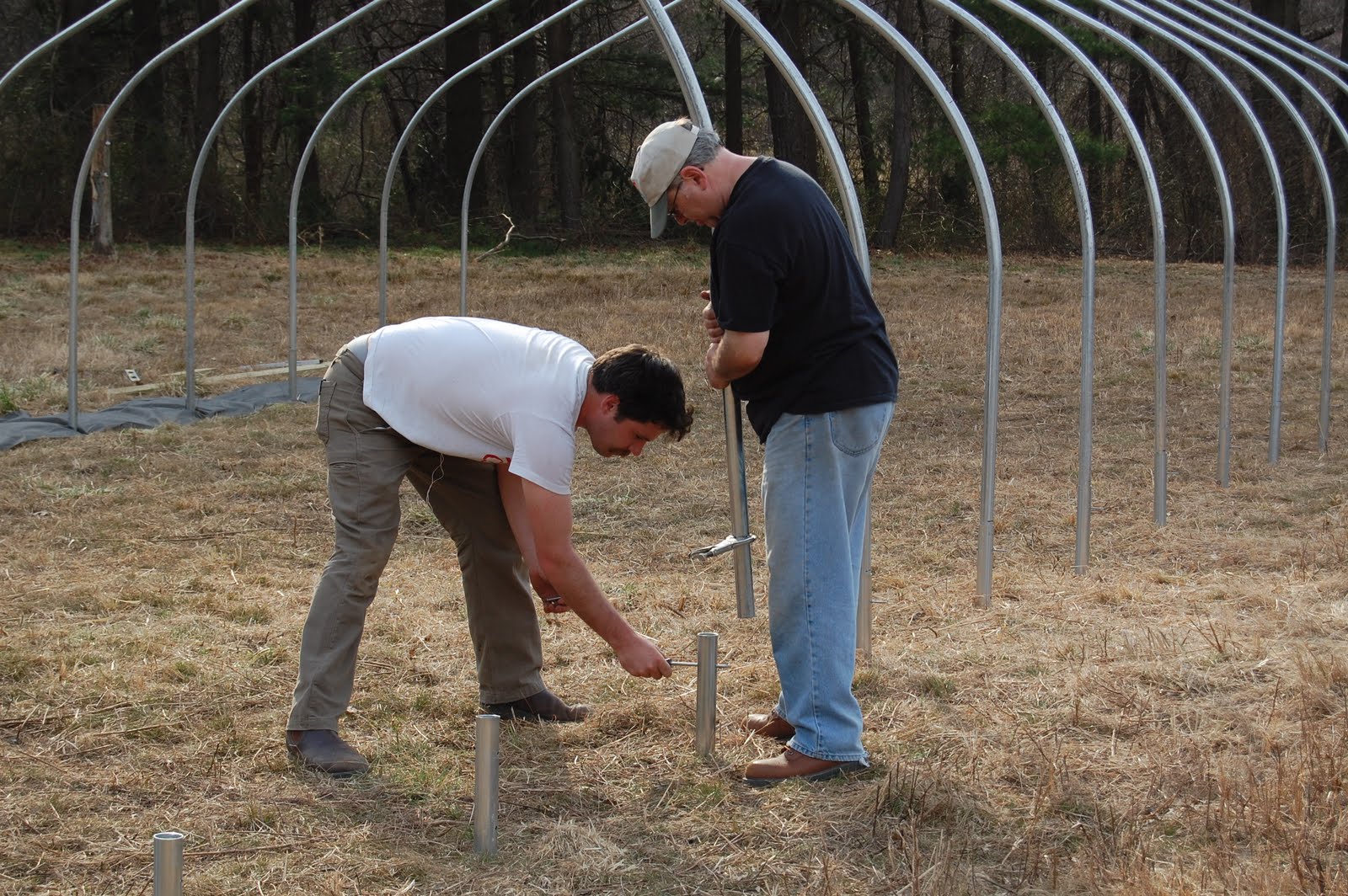
While the posts are being pounded into the ground, the hoops are being put together. Each hoop consists of three pieces that are connected with a bolt and a nut. Both of these steps is very time consuming and took the better part of six hours.

To install the hoops one end is placed in one of the posts. Then it requires team work with one person pushing the hoop to get it in line while the other person pushes the end of the hoop into the post. A vice grip is put on the end of the hoop end to make sure it doesn't go to far into the post. A nail is then inserted through the pre-drilled holes that are now lined up in the post and the hoop end.


After the hoops are in place one cross beam is attached to the top of the of the hoops and two are attached along the upper sides. In the picture you can see Farmer David pointing to the top beam and around waist high you can see one of the side beams.


The reality of life on a farm is that ground hogs are not the farmers friend. They are very destructive of crops. While traps can be effective at capturing ground hogs, the best weapon against them is man's best friend, the dog. Here Hule has dispatched her first ground hog at Z Food Farm.


At the end of a busy day, Hule enjoys a well deserved nap.


There will be more pictures of the construction of the greenhouse in the next post. Until then, happy and healthy eating to all.

Thursday, March 25, 2010

Doing It Again

"Standing in the middle of nowhere, wondering how to begin, lost between tomorrow and yesterday, between now and then. And now we're back where we started. Here we go 'round again, day after day I get up and I say, "I better do it again""

Each spring brings the beginning of a new farm season. Tasks from previous years need to be repeated. The wheel turns and events repeat themselves. There is a sense of stability in the repetitive nature of farming, a sense of reassurance in the renewed beginning of a new season. And while all of this is true for Farmer David there is a different sense of anticipation, excitement, and trepidation in that Farmer David is establishing a brand new farm. Just as you plant the seeds that will grow into plants, David is 'planting' and establishing his own roots with Z Food Farm.

As it is in other endeavors, getting things accomplished at a farm always seems to take longer than one would like. This has been especially true in putting the parts together for the green house (more details and pictures about the green house will be in the next posting). Be that as it may, there has been movement forward at Z Food Farm. A tractor has been purchased. Seeding has started. A mail box has been posted. And there has been progress in the building of the green house. There is a little over two months to go before market season starts and there seems to be so much that still needs to be done. In the spirit of Ken Kesey and the Merry Pranksters, there is only one way to go, 'Further'.

If you are going to grow stuff you need to plant the seed in seeding trays with the proper soil mix. Here David is mixing up a batch of soil. There are various components that go into the soil mix- peat moss, vermiculite, lime, greensand, and a couple of other things.While traditional fertilizers can not be used in organic farming, the basic peat moss can be enhanced to provide good growing conditions for the newly planted seeds.


(NOTE- A big shout out of thanks to Farmer Matt at Cherry Grove Organic Farm. Matt, knowing that David's green house would not be finished in time for the beginning of seeding, offered David space in his green house. Also, in a variety of other ways Matt has provided David with assistance. David is greatly appreciative of all that Matt has done for him.)

Once the seeds have been placed in the trays and covered with the soil mix they need to be watered. It sounds obvious, and it is, but the process of watering can not be taken for granted. At all stages of growth, from the initial seeding to the time when the seedlings are planted in the ground, the trays need to be thoroughly watered. While David is doing this initial watering by hand, Farmer Matt has a watering system within his green house that saves an amazing amount of time. David will be installing a similar system in his green house.


This is the first days seeding. While this may not seem to be all that much, these trays are full of bunching onions. Each cell contains 5-6 seeds. One reason for so many seeds per cell is that not all of the seeds will germinate. Another reason is that these are onions that will be harvested and sold in bunches rather than individually.


Here it is, Farmer David's first tractor. It is a Ford 1710. This particular tractor was built in 1986. The tractor was refurbished and is in great condition. Long may you run.


And here is Farmer David peering into the future, contemplating what adventures lie ahead. Needless to say the hope is that the adventures, while challenging, will be surmountable. Go forth young farmer.


That's all for now. Next posting will detail the putting up of the green house. Until then healthy eating and peace to all.

Sunday, March 7, 2010

Prairie Wind

I tried to tell the people but they never heard a word I say
They say there's nothing out there but wheat fields anyway
Just a farmer's wife hanging laundry in her back yard
Out on the prairie where the winds blow long and hard

Z Food Farm may not be on a prairie, it is in Lawrenceville NJ, but wheat fields and a farmer's wife hanging laundry does convey a pretty picture. At this time things at Z Food Farm are moving along at a steady pace, but in truth it is the calm before the storm. In the calm Farmer David has been making some purchases. Among them- produce crates, components for his soil mix, the various parts of what will be his irrigation system, a green house (hoop house) and a tractor. David has also ordered his seeds (which took an extensive amount of time to do) and they have started to arrive. He's also been working on the paperwork for organic certification. The approaching storm is the green house needs to be built, a deer fence needs to be put up, and seeding needs to start. At this time the putting together of the components of the green house has been somewhat delayed by (dramatic pause) the weather. Yes fans of farming, it is early March and already the weather has had an impact on things. Those of you in New Jersey might have vague recall of those snow storms that dumped record amounts of snow on the area. Well, when you have snow on the ground it is challenging to get into the fields to build anything. However, within the next week construction of the green house will commence and once that has been accomplished it will be full speed ahead. It is hoped that the snow is not a harbinger of weather challenges in the coming months. If you recall from last farm season the rainy weather of June had a significant impact on the entire season. Hopefully the coming weather will be kinder to all farmers.

Michael Pollan, in his book, "In Defense of Food" offered a rule to those interested in healthy eating and the importance of healthy sources of food, "Eat food. Not too much. Mostly Plants." Well, Mr. Pollan has expanded on his rule in his most recent book, "Food Rules - An Eater's Manual". If you are interested in reading more about this, apart from buying the book, you can go to an article/interview in the New York Times (Jan. 8, 2010) by Tara Parker-Pope:
http://well.blogs.nytimes.com/2010/01/08/michael-pollan-offers-64-ways-to-eat-food/?scp=1&sq=Michael Pollan Offers 64 Ways to Eat Food&st=cse

An influence on the work of Mr. Pollan is the work of Wendell Berry. To close today here is a quote from an essay of Mr. Berry's from the most recent book containing his essay's "Bringing It To The Table - On Farming and Food", "Eaters must understand that eating takes place inescapable in the world, that it is inescapably an agricultural act, and that how we eat determines, to a considerable extent, how the world is used."

Mindful, happy, and healthy eating to all.


Here's Hule exploring her new farm. It is her farm. She allows Farmer David to think it is his.


Before the snows came, Farmer David borrowed a tractor with a mowing attachment. Cutting the growth will make it easier for the soil to be turned as part of the seeding process once spring finally rolls around. Thanks to Farmer Kelly of Cherry Grove Farm for the loan of the tractor.


In this picture you can see how high things had grown.


This is what the field looked like after the mowing.


The moss will be combined with compost, a soil, and other ingredients to make up the soil mix in which the seeds will germinate in the seeding trays.


On the left side of the picture are 'hoops' that will support cloth that will be placed over the plants in the field. The cloth will create a 'hot house' effect to help promote the growth of the plants. Center front you can see some ground cover- this plastic will be placed on the raised beds and once the plants are in the ground will aid in the suppression of weeds. Center back and right are components of the irrigation system. Think of a dripper hose that you might use to water flowers or shrubs in your home garden.


Peace and good eating to all.